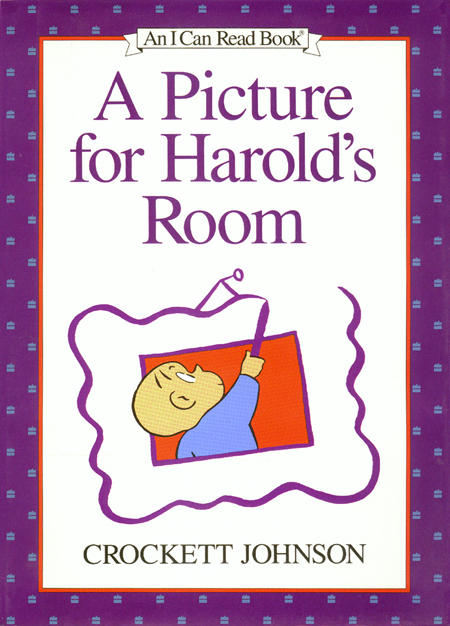
It had been five years since “Harold and the Purple Crayon,” but 54-year-old Crockett Johnson decided that Harold had a new problem.
The book has always been one of my favorites because of its matter-of-fact approach to what’s basically magic. Harold draws a house, and then more houses, and hen a forest and a long road. Johnson draws Harold standing far in front of them in the foreground. “It will look pretty in the moonlight,” says Harold – and then draws a crescent moon. And this leads to what becomes the book’s biggest surprise.
It’s my favorite picture in the book, because to draw the moon in the sky Harold has to step into his purple picture. He stands on the horizon – the baby towering over the little town he’s drawn. And he smiles as he draws a moon that’s half the size of his head. Children spend years as the tiniest thing in the room, so this book offers a very special experience. Instead, Harold is suddenly bigger than everything.
I love its black ink drawings, shaded in white grey – with everything else in a colorful purple from Harold’s wonderful crayon. Giant Harold doesn’t want to scare his town’s people, so he tiptoes around its tiny purple houses and off to draw purple hills. Harold now draws tiny clouds with his crayon before apparently getting tired of land. He adds waves for an ocean – and little seagulls in the sky – and now he’s a giant walking through the ocean, sketching in a tiny ocean liner, whale and sailing ship.
These books have always shared a special message: that your imagination is simply wonderful. Just holding the purple crayon is enough, and armed with its magic, Harold’s pictures just keep coming. On the other side of his ocean, he draws a lighthouse (so his sailing ship won’t crash on the rocks). He’s bigger than the tallest mountains, and ducks under the fast jet planes he drew. And then he methodically creates an adorable railroad by drawing two rails and its tiny ties that crisscross all the way towards the horizon.
It’s was here that I realized that maybe Harold is really Crockett Johnson, the book’s illustrator. They can both see whatever they want to – just by drawing it – and seem more interested in the than in the technique. Birds and flowers around the railroad tracks? “People like to see things from trains,” Harold says.
But the ultimate proof is in the book’s funny dilemma. Harold’s railroad ties stretch to the foreground – growing bigger and bigger – and they’re suddenly big enough to dwarf Harold. While he was watching for trains, he’s become tiny again. “He was half the size of a daisy! He was smaller than a bird!” Now he’s too small to cross the ocean, and to short to climb the mountains. He asks a purple mouse for advice, and sits on a tiny pebble to think.
What would artist Johnson do? Simple. He draws a big purple X through the picture. “I am not big or little,” Harold says. “I am my usual size.” He draws a door that leads back to his bedroom, and the performs one last errand.
In the bedroom that he’s just drawn – he finally draws a tiny picture that’s just for his wall.