Archives

Loopy, by Hardie Gramatky

Loopy, by Hardie Gramatky

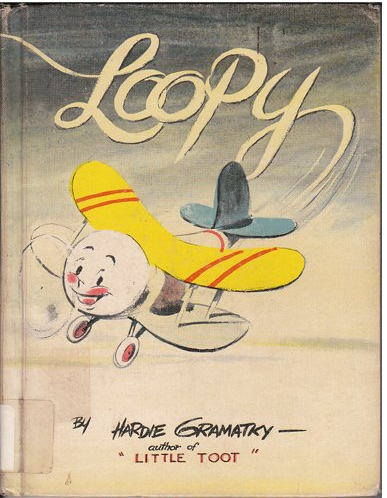
“Little Toot” wasn’t his only children’s character. Two years later Hardie Gramatky wrote and illustrated another story about a child-like airplane (who looks a lot like the red-cheeked tugboat) — called Loopy!. “Loopy is a small airplane,” the first page announces – “the kind that flyers cheerfully call a hedgehopper.” A picture shows the speeding airplane with big round eyes and a smile on its face. It startles the cows and donkeys on the ground as it takes off over the trees. And in one drawing, it even flies over a familiar-looking tugboat in the river!

The funny drawings are filled with broad swatches of colors – something you’d expect from a former Disney animator. But Hardie Gramatky talent had many admirers. Two years ago Andrew Wyeth was asked to make a list of the greatest American artists in watercolors, and he named Edward Hopper, George O’Keefe Winslow Homer….and Hardie Gramatky. One drawing is filled with red – the drawing that warns “One mistake, and the ground feels very hard indeed.” And another illustrates Loopy’s feeling like “something shot out of a Roman candle” by drawing his trail across the sky as a spectacular pink streak. There’s a tight pink circle as the plane dreams of soaring across the sky. One reviewer described many of the book’s colors as “nautical blues and greens and stormy blacks, painted in a dashing off-hand manner.”

Loopy flies student pilots – who sometimes fly him too close to the jets, or once, straight into a clothesline. The plane winces as he bounces along a runway, leading to a lengthy grounding and service by mechanics. What does Loopy want? To fly free across the sky, without a pilot to steer him. He writes “Loop the loop with Loopy” in fancy letters across the sky, and soars speedily in front of a flock of seagull. But instead, a showoff climbs inside the disappointed plane.

“The wind blew like a hurricane” as the amateur flies directly into a storm cloud. The lightning flashes in their face. The instrument dials glare like angry faces. And then the pilot abandons Loopy altogether. But the plane realizes this is his moment, and he rises to the challenge. “Loopy’s stubby little fuselage contains a stout heart,” reads the dust jacket. The plane pulls out of a nosedive. He startles an eagle on a hillside. He even flies derisive circles around the parachuting pilot. Loopy beams, and returns to fame – and the skywriting gig that he’s always dreamed of.And a parade of birds follows him home in triumph.

Curious George’s First Day of School, by Margaret and H. A. Rey

Curious George's First Day of School

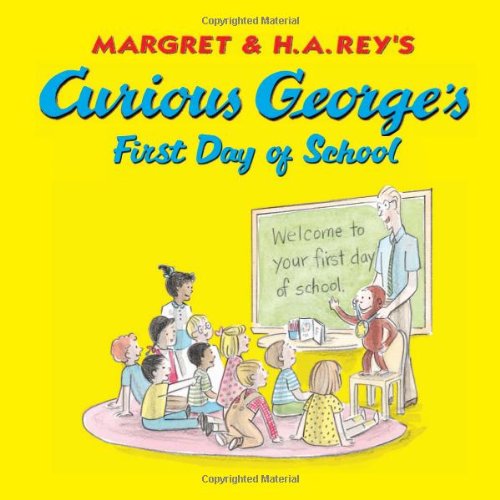
It was 64 years after the first “Curious George” book — and 28 years after their author had died — that the monkey had his first day at school. Houghton Mifflin wrote new adventures, saying they were illustrated “in the style of H.A. Rey.” The drawings seem a little generic, but the formula is the same. It’s the everyday life of a monkey in the city — and you know he’s going to get into mischief…

“You have a big day ahead of you,” says the man with the yellow hat before he drops George off at school. (You’d think after all these years, he would’ve learned not to leave the monkey alone!) George is a “special helper” for the children, holding books up at story time and letting the children practice counting on his toes. “And at recess George made sure everyone had a ball,” the text explains — as an illustration shows George tossing 10 different balls to the children.

But soon George has made a mess with the paints, and he ventures off on his own to find a bucket and mop. A janitor chases him, and George spills water onto the classroom floor — right in front of the school’s principal. “[P]oor George. He felt terrible. Maybe he was not such a good helper after all.” But the children all liked George, and pitched in to help clean up the mess.

Unfortunately, that’s the end of the book. It’s half as long as the original stories written by H. A. Rey, and that eliminates the wild escalation that George’s adventures always used to have. For example, in “Curious George gets a Job,” the monkey steals spaghetti, then gets hired as a window washer, then gets chased down the fire escape by some painters and winds up in the hospital — before appearing in a movie. And in the original “Curious George,” he’s captured from the jungle, falls off a boat, phones a false alarm to the fire department and ends up in jail — before floating away in a bundle of stolen balloons. But in this story, there’s just one adventure. George goes to school and spills paint (and spills water cleaning it up). I wonder if the series would’ve been this popular if the original stories had been this short!

Instead, the original adventures sold 30 million copies. But some critics have argued the stories need to be revised as the world starts to change. In the original 1941 story, “Rather than an eco-tourist, the Man in the Yellow Hat is a gun-toting poacher,” wrote the Wall Street Journal. Maybe we should be glad that in 2005 — the monkey is simply helping out at an elementary school!

Katy and the Big Snow by Virginia Lee Burton

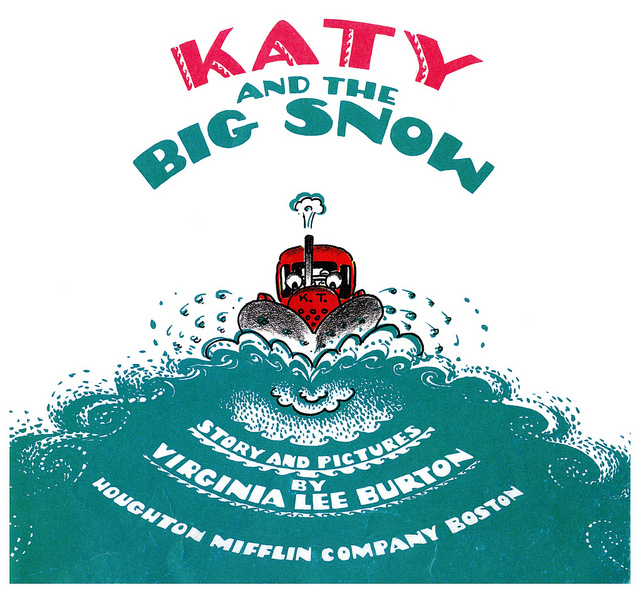
“Katy and the Big Snow” is a classic children’s story from 1943. It had been five years since Virginia Lee Burton wrote “Mike Mulligan and His Steam Shovel.” Now she turned her attention to another piece of talking machinery — this time, a big red snow plow.

Katy is “a beautiful red crawler tractor” that belongs to the city of Geoppolis — and this book shows her in several detailed drawings. When the city is snowed in, there’s a two-page spread that’s almost completely white — representing snow — with Katy appearing in the upper-left corner beginning to clear out a path. Gradually more parts of the city start to appear on the pages, as though Katy has released them from enormous white snow drifts. That’s the book’s big surprise — watching the parts of the city appear from the big blanket of snow.

Burton draws the buildings small, so she’ll have room for the entire city, and the simple illustrations are busy and intricate. One page has 26 different vehicles drawn in the margins around the center picture’s frame — and the next page has 32 different drawings of the red snowplow in action! There’s one two-page spread that has no text at all, just a map of the city of Geoppolis. (It labels 30 different buildings, including the schools, farms, city services, and local businesses.) Because Burton drew the buildings small, she has room for the entire city, and she users only a limited number of colors in the pictures. Unfortunately, I think this robs the book of some of its magic…

I remember being frustrated by this book when I read it as a child. It seemed like there were too many pictures — and the text didn’t really tell a story. It just offered random facts about the city’s highway municipal department. (“When winter came they put snow plows on the big trucks and changed Katy’s bulldozer for her snow plow….”) Some of the dialogue actually comes from the Superintendent of the Water Department. Katy plows out the city — then goes home. The end.

Here’s an interesting thought about this book — it was written in the middle of World War II. America was rationing foods, fuels, rubber, and even shoes. Franklin Roosevelt had expanded the size of the government, and now men were leaving their families to serve in a larger national effort. Great efforts were made to assure Americans that we were all in this thing together.

And when the city was covered by an enormous blanket of snow — Katy the big red snow plow came and plowed everybody out.